Holding Space for Myself in Family and Culture
From a young age, my father had me living in two different worlds that often contradicted each other. At home, I was encouraged to be empowered, independent, and ambitious — a girl who could think for herself and chart her own path. Yet, when his extended family visited, I was expected to play a more submissive, “good girl” role. I don’t believe this was done intentionally to make me insecure, but that was the effect it had. We never worked on combining these worlds to make them work for me; instead, the focus was on being respectful of Bengali culture, which often came at the cost of my mental health. Today, while I embrace being an independent woman who doesn’t care what others think of her, the teenage girl in me still hesitates to rock society’s expectations or contribute further to the stigma that has followed me.
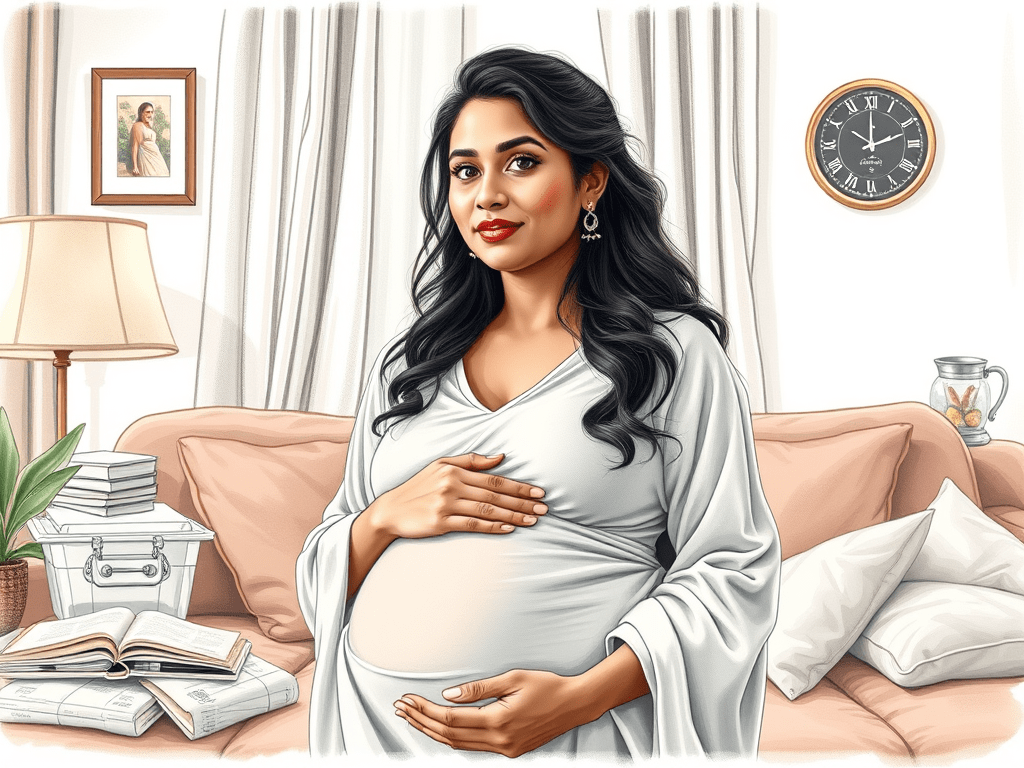
Pregnancy is often portrayed as a universal experience — the glow, the cravings, the congratulations. But in reality, pregnancy unfolds within the context of culture, family, and community. For me, navigating this chapter of life as a Bengali American woman choosing single motherhood means balancing two worlds: honoring the traditions I come from, while also giving myself permission to live on my own terms.
What I Share, and What I Keep Close
One of the first lessons I learned in this journey is that not every community is a safe space for sharing. In some circles, my pregnancy is celebrated openly — friends who see it as an act of courage, a conscious embrace of love and responsibility. In others, silence feels safer. There are cultural and generational lenses that frame single motherhood as failure, shame, or even defiance.
So I make choices: who gets to hold this story with me, and who does not. It’s not about secrecy. It’s about self-preservation, about protecting my joy and my child’s beginnings from narratives that could weigh us down before we even start.
My Brother’s Protective Role
In many ways, my brother has always been my shield — though it took him time to understand why. When we lived in Dhaka and attended the American School for four years, life was complicated. I could wear shorts to school, but in front of family I had to be fully covered. That contradiction was a mind-fuck. As a boy, he had a lot more freedom, while I lost much of mine, navigating cultural expectations, strict dress codes, and constant, cruel gossip from aunties — all of it completely manufactured.
He didn’t fully understand what it felt like to live in that tension until much later. Now, with two daughters of his own, he sees those years through a new lens and has become fiercely protective of my mental health. Today, as I step into single motherhood, he plays that protective role again. He doesn’t just help me logistically — he guards my space, reminding me that I don’t have to justify my choices to anyone.
That loyalty has roots in our shared childhood. As kids, we understood what stigma felt like — the whispers, the judgments, the weight of being different. We learned resilience early, even before we had the words to name it.
The Tension of Roots and Autonomy
Being Bengali is an inseparable part of who I am. The language, the food, the music, the rituals — they are woven into my DNA. But woven into that tapestry are also expectations: that daughters will marry, that families will stay intact, that loyalty sometimes means sacrifice.
To choose single motherhood is, in some ways, to step outside of those lines. It’s a decision that asks me to claim autonomy even when it may look like rejection of tradition. But I don’t see it as rejection. I see it as adaptation. I honor my roots by carrying forward the values that matter most — resilience, loyalty, and love — while also making space for new forms of family.
What I’ve realized is that holding space for myself isn’t selfish. It’s essential. To step into motherhood fully, I need to protect my peace, guard my joy, and trust my instincts. That sometimes means setting boundaries with culture, and sometimes means finding empowerment inside it.
My child will inherit both worlds — the richness of Bengali heritage and the freedom of American choice. My job is not to erase one for the other, but to teach them how to stand tall in both.
Reflection
Balancing these two worlds isn’t easy. There are days when I feel the tension acutely, when cultural expectations brush up against my independence, and I wonder if I’m letting someone down. But then I remind myself: I am not breaking tradition; I am building on it.
My family’s story has always been one of adaptation — of leaving one country for another, of holding tight to what matters and learning to let go of what doesn’t. Choosing single motherhood is just the next chapter in that story. It is a choice rooted in love, shaped by resilience, and strengthened by both my Bengali roots and my American freedom.


 Bureaucrat to Baby Steps
Leave a comment