Survival Mode and Invisible Labor
Birth is immediate. It is visceral and consuming and unmistakably human.
In my case, it was also carefully planned—and then suddenly not.
I went into the hospital for a scheduled induction because of gestational diabetes, prepared for a long but controlled process. We expected a large baby, close to nine pounds. I had a doula. A companion. A close friend ready to support me. I had been working out intensely throughout pregnancy, training my body with a specific goal in mind: to give birth using the squat bar, to stay upright, to minimize perineal tearing, to feel strong and capable in my body.
For a while, the plan seemed to be working.
The induction progressed. Labor unfolded hour by hour. I labored for twenty-five hours, adapting, breathing, enduring. And then the data shifted.
The baby’s heart rate began showing signs of distress. My own body followed—fever, chills, the unmistakable sense that something was wrong. What had been a controlled medical process turned into an emergency calculus. Infection was suspected. Sepsis was on the table.
Within an hour, I was rushed into the operating room for a C-section.
The pivot was total. The plan disappeared. The focus narrowed to survival—mine and my baby’s.
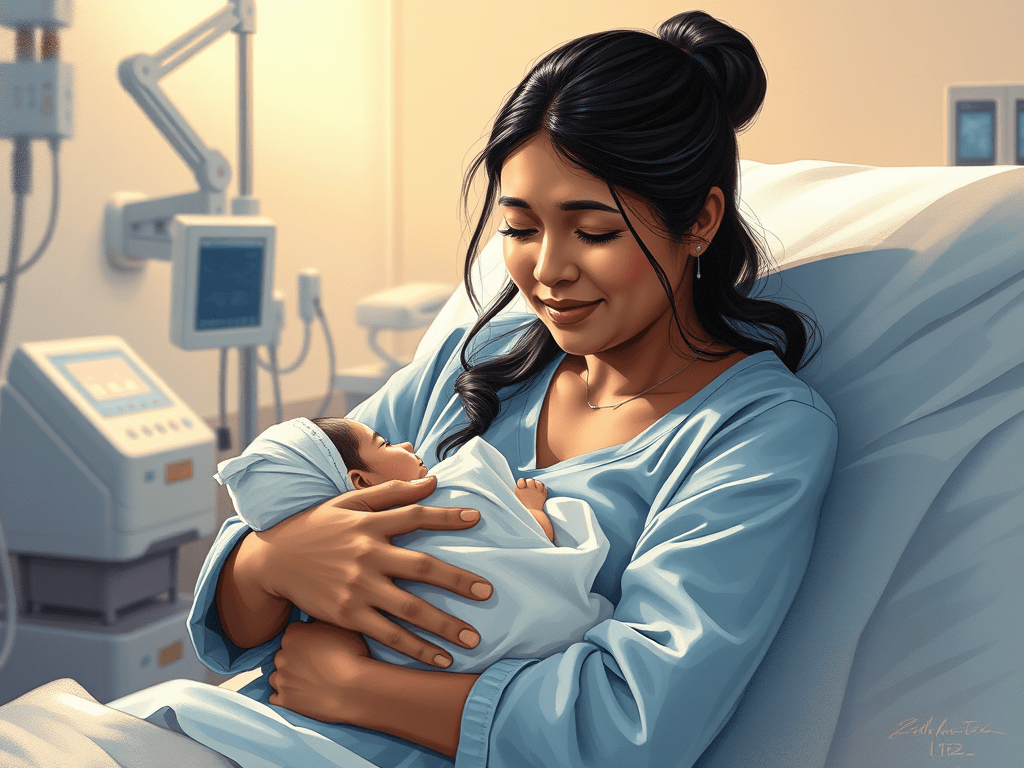
After birth, my daughter and I were, medically speaking, doing well. Recovery was steady. There was no dramatic crisis anymore—just the slow, fragile work of healing after emergency surgery while learning how to care for a newborn.
The hospital wanted to send us home within forty‑eight hours.
I pushed back.
I quoted the law that allowed me to stay up to four days. Not because I wanted to linger, but because I understood what was coming next. Home would mean fewer hands, less guidance, and the full weight of responsibility arriving all at once. I wanted time—to rest, to recover, to ask questions, to have support while my body was still raw and my confidence still forming.
In particular, I wanted access to a lactation consultant.
That support, it turned out, was mostly theoretical. Two of the three lactation consultants were out on holiday leave. The one on duty made it clear she was overwhelmed. She told me how busy she was. She gave me five minutes.
I was exhausted. Frustrated. Angry. I had advocated to stay for care that technically existed but was functionally unavailable.
By the third day, I chose to leave early anyway.
Not because I was ready—but because the promise of support no longer matched the reality. One moment you are laboring—physically, emotionally, existentially—and the next, the world expects you to begin recovering on a schedule it already set for you.
Birth is a medical event, yes. But it is also a bureaucratic hinge point. A single moment that triggers an avalanche of administrative consequences: insurance changes, benefits clocks, leave calculations, documentation requirements, new eligibility rules. Systems react to birth faster than they respond to recovery.
The body, meanwhile, moves at its own pace.
The Lag Between What Happens and What Counts
In the hours after birth, care is intense and constant. Nurses rotate in and out. Vital signs are checked. Forms are signed. Bracelets are scanned. The system is alert, responsive, hyper‑present.
And then—almost imperceptibly—it begins to pull back.
By the time you leave the hospital, the scaffolding disappears. The follow‑up care is sparse. The expectations are high. Heal. Feed a newborn. Sleep in fragments. Learn a new body. Manage pain. Monitor bleeding. Watch for warning signs. Answer emails. File paperwork. Confirm insurance coverage. Submit claims. Update records. Make decisions you don’t yet have the capacity to fully understand.
The immediacy of birth is met with the lag of systems catching up—if they ever do.
The Six‑Week Cliff
Six weeks is treated as a finish line. A neat administrative window that signals readiness: to return to work, to resume productivity, to function.
Medically, six weeks is often when you are “cleared.” Cleared to exercise. Cleared for sex. Cleared to go back.
But cleared does not mean healed.
At six weeks postpartum, many bodies are still in recovery. Muscles remain unstable. Pain lingers. Hormones are recalibrating. Sleep deprivation compounds everything. Emotionally, the ground is still shifting—identity, relationships, confidence, fear.
And yet this is when support drops off.
Leave ends. Benefits change. Expectations reset. You are meant to re‑enter systems designed for people who are not actively recovering from a major physical event while caring for a completely dependent human.
This is the postpartum cliff: the moment when vulnerability collides with policy timelines that were never built for healing.
Recovery as Unpaid Work
Postpartum recovery is labor. It is physical labor—rest, exercises, wound care. It is cognitive labor—tracking symptoms, remembering appointments, learning new information under exhaustion. It is emotional labor—holding fear, joy, grief, and responsibility all at once.
And it is administrative labor.
Filing for leave. Navigating insurance. Correcting errors. Advocating for coverage. Coordinating care across providers who rarely speak to one another. Managing benefits systems that assume clarity, time, and energy precisely when all three are in short supply.
None of this work is paid. Little of it is acknowledged. Most of it is invisible.
The expectation is that recovery happens quietly, efficiently, and on schedule—preferably without disrupting productivity or requiring additional support.
Policy Time vs. Human Time
Public and private systems rely on timelines: six weeks, twelve weeks, eligibility windows, enrollment periods, return‑to‑work dates. These timelines are administratively convenient. They are measurable. They fit neatly into spreadsheets and HR platforms.
Human healing does not.
Bodies recover unevenly. Caregiving intensifies before it eases. Emotional processing lags behind physical milestones. Stability is not restored on a predetermined date.
When policy timelines fail to align with human timelines, the burden shifts to individuals—most often women—to absorb the gap. To compensate. To push through. To manage quietly.
The Question Beneath It All
Why is one of the most vulnerable periods in a person’s life treated as a short administrative window?
Why do systems designed to manage risk and care retreat precisely when long‑term support would matter most?
Birth may be the moment everything changes—but the work of recovery, caregiving, and survival unfolds long after the paperwork says it should be over.
When I got home, what held us was not an institution but people.
Friends and neighbors brought food. They checked in. They helped create a soft landing. That informal care made the transition survivable—it set me up for success in ways no formal discharge plan ever could.
Still, the first nights were brutal.
The baby was up every few minutes, crying, wanting to eat. My milk supply had not fully come in yet, and she had been receiving formula in the NICU. Every attempt to feed felt urgent and inadequate at the same time. Sleep came in shards.
On the second night, I asked my companion to sit with me—not to fix anything, just to help me feel less overwhelmed. I am deeply grateful he was there: holding my hand through those early nights, caring for the dogs, cleaning, cooking, carrying the household while I recovered from surgery and learned how to be a mother.
After the first week, I began to acclimate—slowly, deliberately, mindful that my body was still healing from a C-section. Recovery required restraint as much as effort.
And then the administrative work arrived.
I realized the hospital had failed to add my baby to our SNAP and Medicaid benefits. Two weeks after abdominal surgery, I went in person to the benefits office to correct the error. Medicaid coverage was eventually resolved. SNAP was not.
I am now requesting a fair hearing because my information continues to be entered incorrectly in the system.
Around the same time, I received a letter from Medicaid denying coverage for my C-section—classified as elective. An emergency surgery, following signs of infection and suspected sepsis, reduced to a checkbox error.
In the first month postpartum, while healing, feeding a newborn, and learning a new life, I am also gathering documentation from my medical team to dispute the denial.
This is not a failure of individuals. It is a mismatch of time.
And in that mismatch, invisible labor becomes the price of entry back into normal life.
This is where community stopped being optional—and became the only thing holding the gaps together.


 Bureaucrat to Baby Steps
Leave a comment